

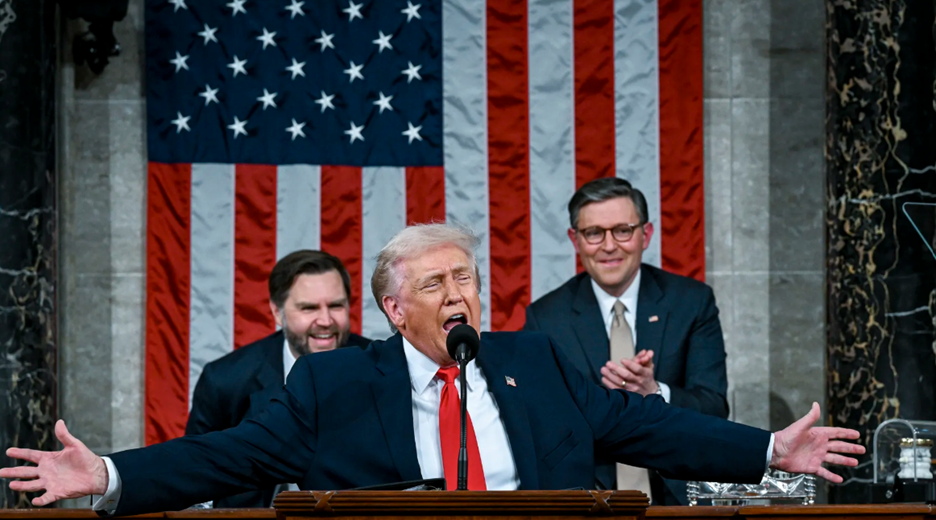
Let us begin this month’s newsletter by analyzing the State of the Union address recently delivered by President Donald Trump.
The last year has been a volatile one for the markets and for geopolitical news. President Trump was quick to point out that the stock market has made 53 new highs since he took office for a second term in 2025. And yes, the markets have indeed been in a solid uptrend since it was announced that he had been reelected in November 2024.
Stock Market Highs
However, when you look at this market rally from the perspective of the U.S. currency, these phenomenal new highs have largely been achieved at the expense of the U.S. dollar. Although the stock market has been strong, the dollar has gone through a period of exceptional weakness. It could be argued that this is part of the overall Trump administration plan to redirect the U.S. economy toward manufacturing and exports. A weak U.S. dollar makes American exports more attractive internationally.
Jobs & Inflation
President Trump also focused on the turnaround in job creation and the steep decline in inflation. He pointed out that more Americans are working now than at any other point in history. His opponents, however, would most likely argue that many Americans are working multiple jobs, meaning they are unable to support their families with a single full-time position. This trend may also be linked to the drastic economic and technological changes that have occurred since the advent of the internet and the smartphone.
AI and The Grid
President Trump also addressed the recent challenge of sourcing power for artificial intelligence companies. To recap, AI development demands a tremendous amount of electricity from a grid that is already stretched to its limits. His proposed solution requires companies building artificial intelligence systems to generate power for their own use. This would reduce pressure on the grid and prevent price increases from being passed on to residential consumers.
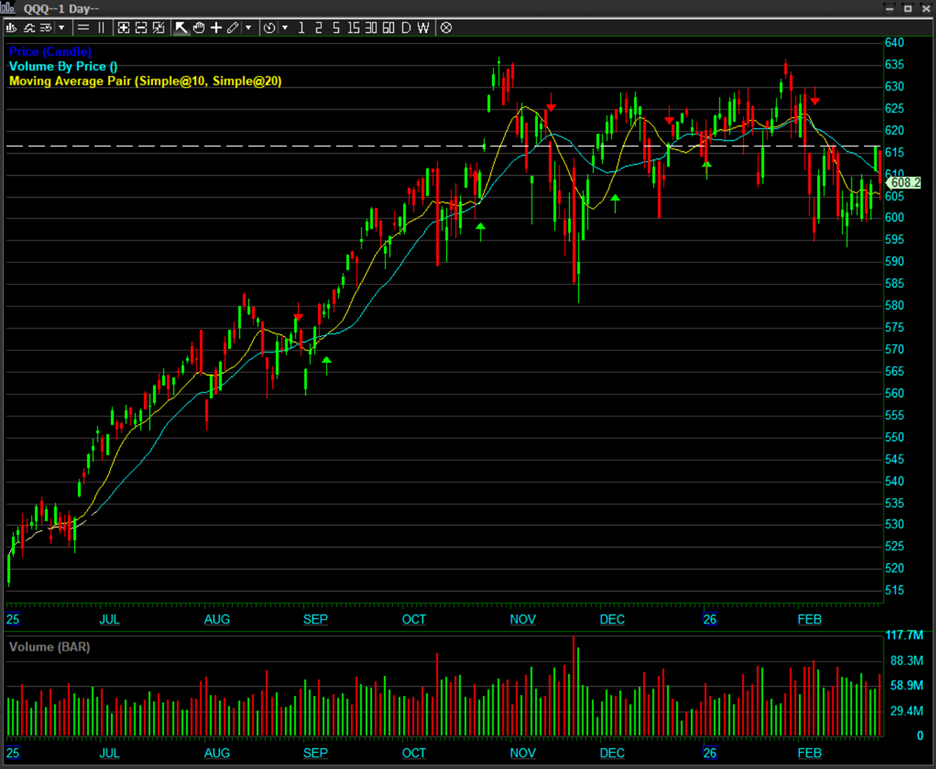
The Chart of the $QQQ which represents the Nasdaq 100 ETF shows the tech sector making repeated new highs, up until the end of last year, since then markets have been far more volatile. So traders and investors should be cautious, technically a market correction would be healthy for the markets to digest recent gains.
Tariffs
Let us now address the biggest elephant in the room: trade tariffs. Last year’s market volatility was largely related to Trump’s use of reciprocal trade tariffs as a bargaining tool to renegotiate agreements with international trade partners. Recently, the Supreme Court struck down the reciprocal trade tariffs as unconstitutional. The Trump administration quickly countered by raising tariffs across the board in a manner deemed constitutional.
The ultimate outcome of this ongoing trade tariff drama remains to be seen. Hopefully, it will be resolved by the end of 2026. In the meantime, we should expect markets to continue reacting to every trade-related announcement.
Government Shutdown
Last but certainly not least, President Trump requested that Congress pass immediate funding for the TSA and Homeland Security, as a partial government shutdown is still in effect.
In conclusion, partisan politics aside, the U.S. economy does appear to be strong and resilient. Inflation is down, and many geopolitical concerns have been successfully addressed. As far as the markets are concerned, they have reacted extremely positively over the past year and two months to the changes implemented by the Trump administration.
Prudence remains the best course of action, as we should expect continued market volatility. Every day seems to bring a new development or concern — the latest being the disruptive impact of artificial intelligence on the software sector. Increased volatility may create excellent opportunities for traders. For investors, it may be wise to consider taking partial profits in case this volatility persists.
Until next time, trade well.