

The month of November is an interesting time of year for the equity markets. It serves both as a prelude to the close of 2025 and as a vantage point from which we reflect on the year that has passed. It also brings to mind Black Friday, which traditionally marked the point when retailers finally moved “into the black” after being “in the red” for most of the year.
Let’s take a deeper look at what that means this time around. On the surface, 2025 appears to be a strong year for U.S. equity markets. Stocks sit near all-time highs when denominated in U.S. dollars; however, the dollar itself has had one of its worst years since the 1970s. Gold, by contrast, has had one of its best years on record, appreciating roughly 60%. The last time gold experienced a return of this magnitude was in 1979. Most of us don’t remember 1979 well—nor the early 1980s—but those were highly transitional years for the financial markets. In the early 1980s, the U.S. economy entered a deep recession as Reaganomics began to take effect. This calls to mind the fact that we also find ourselves in a transitional moment today, with the implementation of significant import tariffs enacted by the new Trump administration.
So, what does this mean for the markets going forward—both in the short term and the long term?
Short-Term Outlook
The stock market has experienced an almost 12-month run-up, fueled largely by a weakening U.S. dollar. A weaker dollar makes U.S. exports more attractive and aligns with the Trump administration’s stated goal of re-gearing the economy toward domestic manufacturing. A weaker dollar makes U.S.-produced goods less expensive abroad and therefore more competitive.
From a technical standpoint, the U.S. market has surged dramatically and is overdue for a correction—typically defined as a pullback of at least 10% from recent highs. In November, we did see a sharp technical correction, followed by an immediate rebound. This type of volatility is often indicative of distribution prior to a broader, more prolonged correction through time. In other words, we should expect continued volatility moving into early 2026.

As Seen in the Chart above, the month of November’s Volatility could be a prelude as to what to expect in 2026.
Long-Term Structural Considerations
The Trump administration has begun reshaping the U.S. economy to be more self-sufficient and manufacturing-driven, primarily through the imposition of tariffs on imported goods. However, these measures were enacted through executive order rather than through Congress, and their legal standing is expected to be reviewed by the Supreme Court. Until then, this economic transition remains in a holding pattern.
In addition, the stock market has experienced a massive boom driven by enthusiasm around artificial intelligence. AI holds enormous potential across industries due to its ability to significantly increase worker productivity. However, the actual productivity gains have yet to materialize in many sectors. As AI continues to replace or enhance roles previously performed by larger workforces, the longer-term impacts on employment and efficiency remain uncertain. Some of the recent surges in AI-related stocks may reflect excessive hype—hype that may need to be tempered as real-world results emerge.
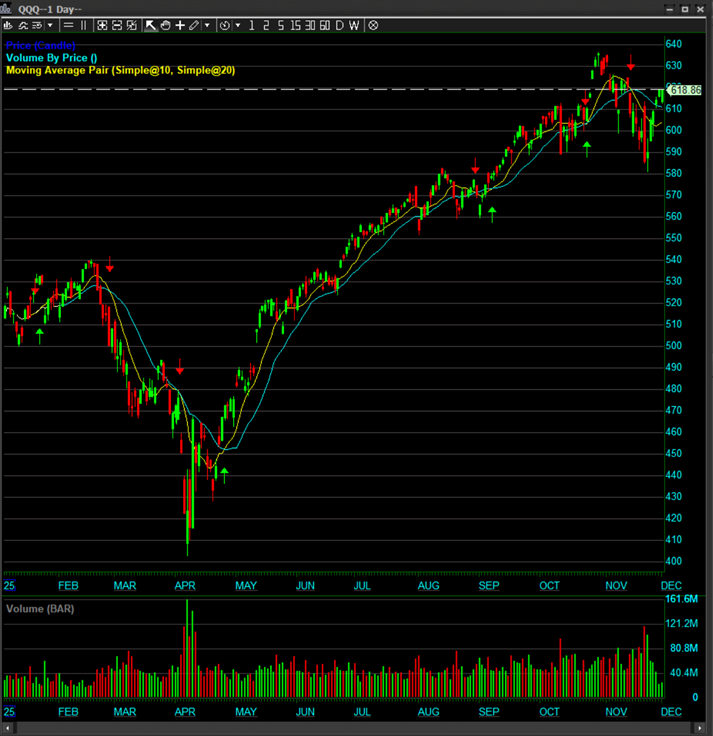
The tech rally of 2025 as seen in the chart of the QQQ ETF above is very impressive, but lows of 2025 are now also very far away, indicating that we might be instore for a healthy correction in the near future.
Conclusion
All in all, November has been a roller coaster, marked by a steep decline followed by a sharp rally. This kind of activity may foreshadow what lies ahead: increased volatility after a prolonged and powerful market advance. While it would be healthier for the market to correct and move sideways to digest recent gains, it is more likely that, given all the transitional forces in play, 2026 will involve consolidation or modest downside as the new economic landscape takes shape. In this environment, it may be wise to adopt a more conservative stance and reduce risk rather than expect another year of strong gains.
On that note, trade well as we approach the close of 2025, and all of us here at DAS Trader wish you a happy holiday season and a wonderful New Year!
Written by Michael DiGioia, Director of Education
Mike is available for One-on-One Coaching. Learn More