
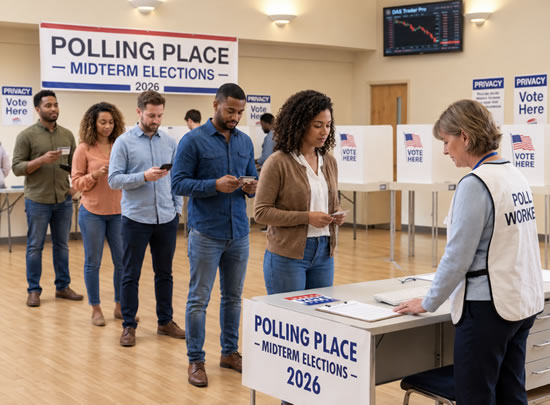
It’s that time of year again: election season!
This year, the United States faces the midterm elections, and I believe they could prove critical for the financial markets. Let me explain why.
Please stay with me until the end, because I’ll return to the central question: Why could these midterm elections be so important for the markets and the broader economy?
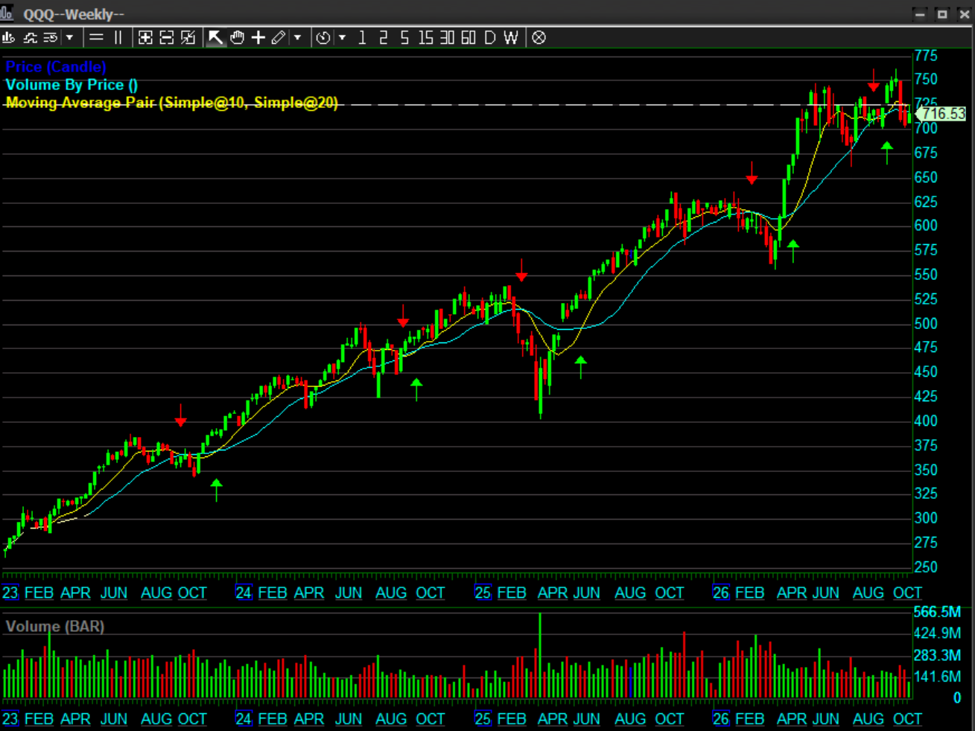
This is the weekly chart of the QQQ exchange-traded fund from 2023; as you can see, up, up, and away! But recently we have gone flat; that might indicate bearishness on the horizon.
The Origin of the Rally
U.S. equity markets have been in rally mode for much of the past two years, with the rally gaining momentum following Donald Trump’s reelection and the Republican Party’s return to power. Markets have responded favorably to policies perceived as beneficial to large industrial and technology companies.
The rally has also been fueled by enthusiasm surrounding artificial intelligence (AI) and its potential to improve efficiency, reduce costs, and increase corporate profitability. Investors have poured money into companies expected to benefit from this technological transformation.
Markets remain near all-time highs. However, some of the economic and political conditions that helped propel them upward are changing rapidly.
Let’s examine these developments one by one and consider why a shift in political power during the midterm elections could put pressure on the current bull market.
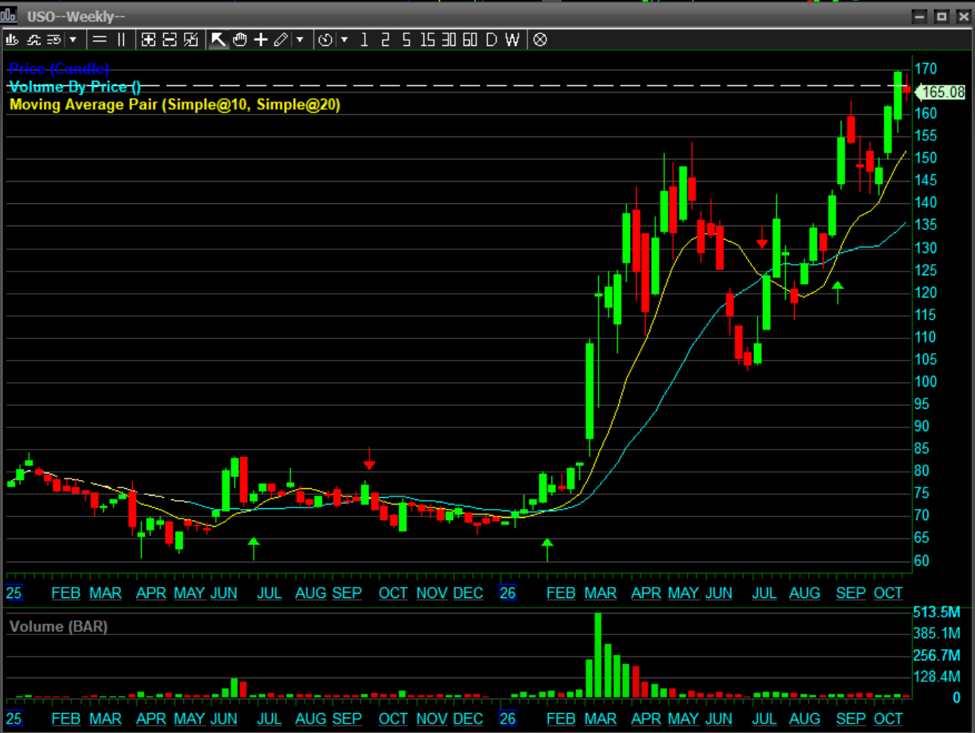
Here we see the USO oil exchange-traded fund, and we can see the explosion in the price of oil that has triggered rising inflation
The High Price of Oil: A Potential Driver of Inflation
Donald Trump campaigned on several key economic issues. One of his most recognizable slogans was “Drill, baby, drill,” reflecting his promise to increase domestic energy production and bring down oil and gasoline prices.
Energy is a critical input across the economy. Higher oil prices increase transportation and manufacturing costs, putting upward pressure on the prices of goods and services throughout the supply chain. When energy costs remain elevated, businesses must either absorb those costs, reducing profit margins, or pass them along to consumers.
Neither outcome is particularly favorable for the stock market.
The war in Iran has pushed oil prices above $100 a barrel. If prices remain at those levels for an extended period, the consequences could be significant. A brief spike in oil prices is something the economy can often absorb. A prolonged increase is much more difficult to manage.
Why?
Because the health of the economy ultimately depends on the financial well-being of consumers. When households spend more on gasoline, heating, transportation, and everyday necessities, they have less money available for discretionary purchases. Consumer spending weakens, confidence deteriorates, and economic growth can begin to slow.
Higher energy prices can also reignite inflation, complicating the Federal Reserve’s efforts to bring prices under control.
Rising Interest Rates and a Weakening Housing Market
Signs of declining consumer confidence and persistent inflation are already adding to concerns about the economic outlook.
If inflation remains elevated, the Federal Reserve could face renewed pressure to maintain restrictive monetary policy or even raise interest rates again. Higher rates make borrowing more expensive for consumers and businesses alike.
The housing market is particularly sensitive to interest rates. Higher mortgage costs make homes less affordable, discourage prospective buyers, and put pressure on construction activity.
We are already seeing signs of strain in the housing sector, with housing starts and new-home sales facing significant challenges.
This creates a difficult situation for policymakers. Higher interest rates may be necessary to contain inflation, but they can also slow economic growth, weaken housing demand, and reduce corporate earnings.
For equity investors, that combination deserves attention.
A Critical Midterm Election
Now let’s return to the midterm elections.
What happens if Republicans lose control of the House of Representatives, the Senate, or both?
The political landscape in Washington would change significantly. A divided government could make it more difficult for Republicans to advance their economic agenda, including policies involving taxes, regulation, energy production, and business investment.
Some existing policies could face greater scrutiny, while proposed business-friendly initiatives might stall or be reversed.
Markets have benefited from expectations of a pro-business political environment. If those expectations change, investors may have to reassess corporate earnings forecasts, valuations, and the broader economic outlook.
It is important to remember that markets respond not only to actual policy changes but also to expectations about what might happen next.
A shift in political power does not automatically end a bull market. However, if investors begin to anticipate less favorable policies, greater regulatory uncertainty, or weaker corporate earnings, market sentiment could change quickly.
What Could Be Even Worse for the Markets?
Beyond economic policy, corruption and government accountability have become important political issues.
If Republicans lose control of one or both chambers of Congress, the new balance of power could lead to increased congressional investigations, subpoenas, and scrutiny of government officials and corporate relationships.
Such investigations would not necessarily establish wrongdoing, nor would they automatically harm the broader economy. However, when specific companies become the focus of major investigations or legal proceedings, their stocks can face increased volatility.
Uncertainty surrounding potential penalties, legal expenses, reputational damage, and future regulation can weigh on individual companies and, in some circumstances, on broader market sentiment.
For investors, the concern is not simply whether wrongdoing occurred. It is the uncertainty surrounding what investigators might uncover, what consequences may follow, and how long the process could take.
Markets generally prefer predictability. Prolonged uncertainty can make investors more cautious, particularly when valuations are already elevated.
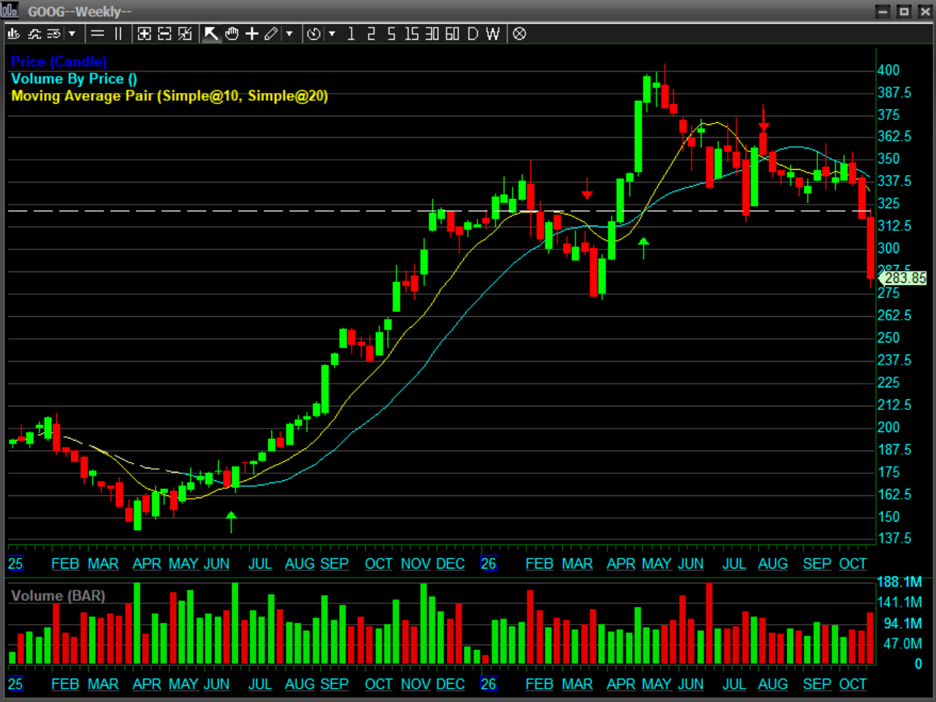
This chart shows GOOG and might be an indicator for the future, as GOOG has had less-than-stellar earnings. Remember that if GOOG is feeling the crunch, then maybe there is more crunch still yet to come.
Caution and Profit-Taking
After the substantial gains of the past few years, investors may want to reconsider their exposure to risk.
The combination of elevated oil prices, persistent inflation, potentially restrictive Federal Reserve policy, a weakening housing market, and an increasingly uncertain political environment creates a challenging backdrop for equities.
The midterm elections could add another layer of uncertainty. A Republican loss could shift Washington from a relatively unified, pro-business agenda toward political gridlock, increased oversight, and a greater likelihood of policy reversals.
For a market trading near record highs, that shift could become an important headwind.
In technical analysis, the term dark cloud cover describes a bearish candlestick pattern that can signal a potential reversal after an advance. While an election result is not itself a technical indicator, the metaphor is fitting: a political shift could cast a shadow over an otherwise strong market.
Investors should also remember that markets often anticipate political outcomes before election day. If a change in congressional control becomes increasingly likely, stock prices may begin reflecting that possibility well in advance.
None of this guarantees that the bull market is over. Markets can continue rising despite political uncertainty, and a divided government can sometimes reassure investors by limiting the scope of major policy changes.
Nevertheless, the risks are worth taking seriously.
After a prolonged rally, protecting gains and adopting a more defensive posture may be prudent. That does not necessarily mean abandoning the market altogether. It means reassessing risk, reviewing portfolio exposure, and avoiding the assumption that recent gains will continue indefinitely.
Politically, economically, and financially, the next two years could look very different from the last two.
The bottom line: uncertainty is returning, and investors should be prepared for the possibility that the market environment is changing.
Until next month, trade well!
Written by Michael DiGioia, Director of Education
Mike is available for One-on-One Coaching. Learn More